After a long tortuous journey and many personal “firsts”, let’s backtrack to the beginning. Time has glossed over nearly every delay, multiple airport cat-naps, the giant millipede and the tent in the tree incident…

North Carolina, the Tar heel state, with a median family income of $65,964 in 2017 (about £ 54,250).
Where I discover how hard it is to define UK Housing Association status (not-for-profit, private entity, charity, public, there are as many models as in the Community Land Trust field), and the housing prospects in the Yorkshire Dales “sounds dismal”. Must use more inspiring statistics in the future. Though I think that’s the point of my mission…
Robert Dowling, Executive Director of Community Home Trust (CHT) , was the first to respond positively all those months ago, when I was trying to persuade Land Trusts in the USA that I was not a “spam” email, or an investor. He has led the Land Trust, covering three counties, since it’s inception in 1999. Patient and softly spoken he succinctly kept me on track through my jet-lag.
The Community Home Trust “model” is evolving and always adapting to demand and need; no-one should live in squalor. From home ownership within communities to meeting rental demand. Current initiatives are exploring how improvements to ownership properties might be incentivised, so that owners want to invest, rather than have to at the point where they try to sell.
The Trust owns both land and home. If not being used for rental, the house is sold with 99 year renewable leasehold interest, the Trust retaining the deed.
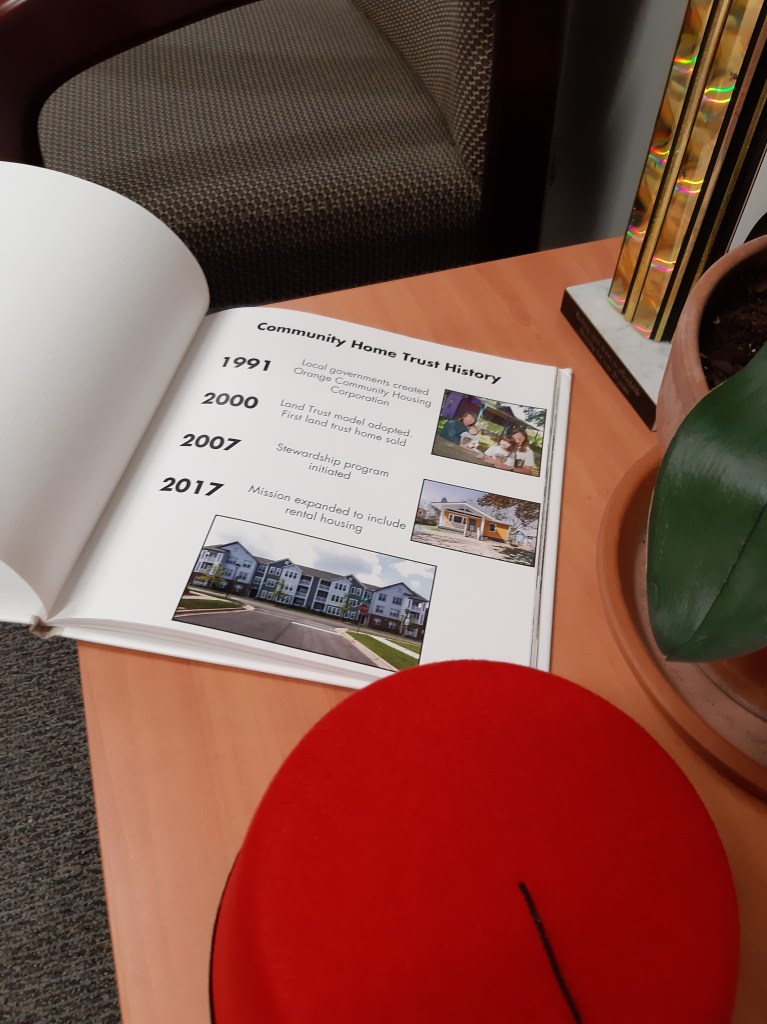
In 2007 the Stewardship Programme was introduced to ensure the ownership properties were kept affordable and in good condition in perpetuity. So for c 210 homes there is a “forced savings” against depreciation and replacement of 5 high cost items in order to keep the homes as well maintained community assets.
Since 2012 the resale formula has been indexed to the Housing and Urban Development income statistics for the area. Homeowners can earn up to 1% appreciation per year on their property if they resell. Of course the longer the owner stays, the better the return – the equity.
CHT started small, first home selling in 2000. By 2005 organisational growth was driven by the inclusionary housing policy, and CHT had sold 100 homes. The main method of acquiring land is now through inclusionary housing led by private developers. That’s not to say CHT has not dipped into putting homes on the ground, but its fraught with “all sorts of peril”. Looking back, the advice would be to never use the lowest bidder, it makes no sense. This sentiment will be echoed across England I suspect.
Some people are not meant to be home-owners and that too makes sense. It’s having the choice, based on personal/financial goals, that’s important. Having home options; housing choices for all income levels, families and stages of life.
The climate in North Carolina is humid and sub-tropical, which is challenging on wooden materials. Certainly property maintenance and keeping the community asset in good condition appears to be one of the key issues for the Trust.
I emerged out of air-conditioning into 34 degrees C, with what must be close to 90% humidity, melted and reflected…
A beginning is the end of something, a new start. Homes are not typically viewed as a community asset; (63% in the UK are in private hands!). However they are the most important community asset along with it’s residents that a rural village can have.
Next: Where the undertaking takes more effort than necessary. And I’m not talking about extracting the tent from the tree.
 On a Mission - learning from the CLT Movement